"I am an experimenter and not a theorist. I call a theorist someone who constructs a general system either deductive or analytical, and applies it to different fields in a uniform way . This isn't my case. I am an experimenter in the sense that I write in order to change myself and in order not to think the same thing as before" (Foucault, 1980.
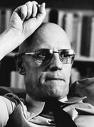
Michel Foucault was born in France in 1926. His father, who was a surgeon, wanted Michel to follow in his profession but Michel entered the École Normale Supérièure in 1946 to pursue a degree in Philosophy. ucault was considered to be intellectually brilliant and entered the university with honors. This was followed by a certification in Psychology, and a diploma in Psychopathology. After graduation, he worked for a short time in a psychiatric hospital, which became the basis for his first book, and taught at various universities around Europe.
Georges Canguilhem, one of Foucault's professors, was hugely influential- offering mentoring and sponsorship toward obtaining his doctorate in 1959. His dissertation, Madness and Unreason: History of Madness in the Classical Age, was published in 1961. "Foucault abolished the possibility of separating madness and reason into universally objective categories. He does this by studying how the division has been historically established, how the distinctions we make between madness and sanity are a result of the invention of madness in the Age of Reason" (Gutting, 2008).
Foucault chaired the philosophy department at the University of Clemont-Ferrand, and at the Vincennes Experimental University Centre and here met a student named Daniel Defert, who was a major influence on Foucault. Foucault traveled with Defert to Tunisia and taught until 1968. Upon their return to Paris, Foucault became involved in student revolts, forming think-tanks of some of the most influential French thinkers and leading the Philosophy Department at the University of Paris-VII at Vincennes. During this time, Foucault worked with prisoners and formed an advocacy group, the Prison Information Group, to give prisoners a way to voice concerns (Gutting, 2008). Foucault defended marginalized populations, frequently speaking in defense of homosexuals, prisoners, and artists.
After this, Foucault held the position of Professor of the History of Systems of Thought at the Collège de France, guest lecturing around the world, until his death from AIDS in 1984.
